The Wall Street Journal recently ran an article (A Victory for Office Small Talkers, October 27, 1014) describing a research effort studying chit-chat and employee retention. The article caught my eye because I have long believed that men and women talk about different things with their co-workers while they are at work.
When I ask my sweet husband how so-and-so's vacation was, he'll say something like he didn't ask and they didn't volunteer; they talked about work. Thinking this was something unusual about my husband, I asked other male friends if they engage in small talk with co-workers during breaks and they all said the same thing - "Work is for work." However, female friends who work outside their home often volunteer social information they learned from a female co-worker - things like a restaurant they went to or a movie they saw. Clearly women talk about things other than work.
This made me wonder if employers prefer "chit-chatting" employees or "strictly down to business" ones.
The article mentioned a study conducted by an assistant professor at the Wharton School at the University of Pennsylvania where she analyzed two years worth of electronic communications (emails, texts, calendar scheduling, etc.) from a little over 8,000 employees at a global information technology consulting firm. She organized communications into categories including a social one indicated by words about meals, sports, etc. Her research showed that employees who used words like "lunch," "coffee," "baseball" and "dinner," for example, were more likely to keep their jobs during company layoffs. In fact, this "small talk" was a better indicator of job retention than how much money an employee brought in to the company.
The researcher suggested that "chit-chatting" employees have value that isn't well measured yet. They could be "influencers" - employees who are well-connected and relate on a more personal level with their colleagues. Or maybe they are more fun to be around and therefore, more valued by co-workers. Or they might boost morale in the workplace increasing overall productivity.
Whatever the reason, while work performance is important, social communication can give a little extra boost. It's time to bring the art of conversation back!
Wednesday, December 10

Wednesday, December 3
wacky wednesday - the things you miss
My mother-in-law, whom we affectionately called Nona, often reminded me to appreciate each age and stage of parenting our children. For example, I would complain about spending all day in my car driving 75 miles to take our darlin's to school and back, to activities, etc. and never travel farther than ten miles from our house. She would laugh and tell me that one day I would miss that. I'm pretty sure there was some eye rolling on my part after that.
Seriously? I would miss stuff like that? What about changing clothes several times a day because the baby spit up - or worse- on me? Would I miss that, too? How about finding out at 9:00 at night that my sweet darlin' had volunteered to bring 5 pieces of poster board to school the next day? Or going on a road trip and answering the question, "Are we there yet?" a bajillion times? I was absolutely certain Nona was mistaken; no one could possibly miss stuff like that.
Fast forward a couple of decades. My sweet darlin's now have sweethearts of their own. And I have learned that Nona did, indeed, know what she was talking about.
In no particular order, here are seven things I never, ever thought I'd miss.
1. Photo-bombing (although back in the day it was just called "getting in the way")
I am almost certain I "talked sternly" to my sweet darlin's for jumping up into my picture while I was trying to take a landscape photo. However, I realized I really do miss the silliness and spontaneity of this prank when one of my sweethearts did it last week.





Seriously? I would miss stuff like that? What about changing clothes several times a day because the baby spit up - or worse- on me? Would I miss that, too? How about finding out at 9:00 at night that my sweet darlin' had volunteered to bring 5 pieces of poster board to school the next day? Or going on a road trip and answering the question, "Are we there yet?" a bajillion times? I was absolutely certain Nona was mistaken; no one could possibly miss stuff like that.
Fast forward a couple of decades. My sweet darlin's now have sweethearts of their own. And I have learned that Nona did, indeed, know what she was talking about.
In no particular order, here are seven things I never, ever thought I'd miss.
1. Photo-bombing (although back in the day it was just called "getting in the way")
I am almost certain I "talked sternly" to my sweet darlin's for jumping up into my picture while I was trying to take a landscape photo. However, I realized I really do miss the silliness and spontaneity of this prank when one of my sweethearts did it last week.
2. Hearing and responding to "Watch this!!!" fifty times a day
Our parenting style was to be engaged and interact with our sweet darlin's when we reasonably could so we heard "Watch this!!" a lot. I remember one summer when they both wanted me to watch them dive in the pool and pick up rings off the bottom EVERY SINGLE TIME THEY DID IT all summer long. It's difficult to be enthusiastic and excited the five hundredth time you've watched it! But I've learned that their wanting me to watch them is really their way of sharing themselves with me. Yes, it's attention-getting but they're sharing something they like to do or something they learned. And I do miss it. Fortunately, the sweethearts have a never-ending supply of things to "share!"
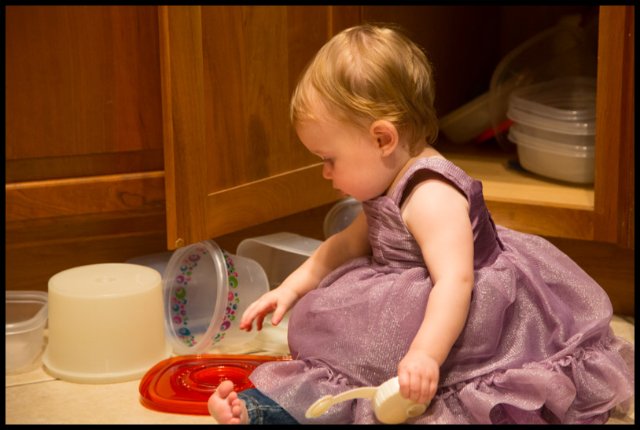
3. The disorder of the tupperware cupboard
Our sweet darlin's quickly learned that they were to leave cupboard doors alone (and closed)... except for the Tupperware cupboard. That one they could open, take all the containers and lids out and play with them (and as they were older, put them away) to their heart's content. Consequently, that cupboard was usually a disorganized, chaotic mess. While I loved watching their delight while they played with "my toys," I also longed for the day when my cupboard would be neat and tidy and finding the right container and lid wouldn't take half an hour. Imagine my surprise when they were older and I actually missed the mess inside the cupboard! I am delighted to have some little sweethearts that like to play in the cupboard.
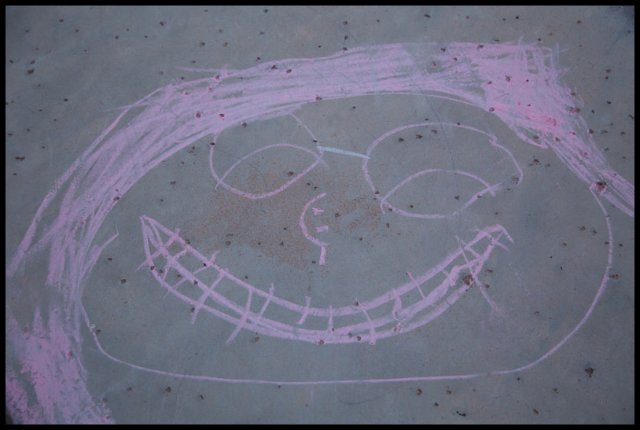
4. Chalk art on the driveway or patio
While doing chalk art is fun and I always loved seeing what they would make, the mess it creates is not so fun. The chalk dust gets all over hands, legs, feet and clothes to then be tracked into the house. Once our sweet darlin's outgrew chalk art I was certain I would never miss it - but I did. Seeing their drawings or, as they got older, messages spread across the driveway as I came home always made me smile. So now I always have a bucket or two of chalk for the sweethearts to draw with - the "mess" is easily cleaned up!
5. Drool and fingerprints on the glass on the back door
I could never understand why both my mother and Nona never seemed to mind if our sweet darlin's put their hands all over a window or a mirror. Who were these women? They couldn't be the same mothers my husband and I had - because we got scolded at for doing that! And we "discouraged" our sweet darlin's from slobbering and putting handprints on glass doors and windows. It seemed like I was forever cleaning them - and couldn't wait until everyone was old enough to not do that. And once they were, I learned what my mother and Nona already knew - that the fingerprints and the drool is a reminder of how little they are and how fast they grow up. And I missed it! Now, when my sweethearts (or someone else's sweethearts) come to visit, I encourage them to fingerprint away and I don't wash it off for weeks or sometimes months!
6. Little feet peeking under the stall door in a public bathroom
When our kids reached an age where they were old enough to go in a public restroom stall by themselves but not quite old enough to be in the public restroom alone, I would use the stall next to them so I could see their feet. If they finished before me, they would plant their feet outside my stall door so I could still see their feet. I was 100% certain I would NOT miss that when the kids got older, mostly because they liked to peek through the cracks in the door to watch me. But, alas, I was wrong again and not only enjoy it but even laugh when I see my sweetheart's shoes peeking under the stall door.
7. Toys scattered all over the floor
Okay, absolutely no one would miss tripping over toys on the floor. And, honestly, I don't miss the tripping - but I do miss seeing toys spread out all over. We have a basket of toys in our family room for young children to play with when they come to visit. Their parents always remind the child to "pick up your mess" but I really wish they would leave it, at least for awhile.
Although Joni Mitchell's song, Big Yellow Taxi, is making an environmental statement, the sentiment in the refrain - "don't it always seem to go that you don't know what you've got 'til it's gone..." - rings true for me.
Wednesday, November 26
wacky wednesday - thankful for that?
Americans have celebrated Thanksgiving since the 1620's as independent colonies and later as states but it wasn't until 1863 in the midst of the Civil War that President Lincoln proclaimed a national Thanksgiving Day to be held each November. For about a hundred years it was a holiday where the entire family gathered together to remember good times, be thankful for all the blessings in their lives and maybe watch (or play) a little football.
I have watched our society, little by little, lose the meaning and tradition of the Thanksgiving holiday. Every year it gets harder to keep a heart filled with thanksgiving and gratitude. Hollywood tells us family is lame (Home Alone comes to mind). The media tells us that instead of being thankful we should be fearful (ISIS, racial unrest, Ebola, politics). Retailers tell us we don't have enough "stuff" and need to go shopping with millions of other people on Thanksgiving Day to get "good deals" and boost the retailers bottom line.
And that's just the everyday, average American with everyday, average problems. People who suffer with serious medical issues, are jobless or homeless, are struggling with serious relationship problems or a host of other concerns often don't feel thankful at all; they feel hopeless.
So how do we have "an attitude of gratitude" even when we feel lost, fearful or hopeless?
I think the Apostle Paul answers that question in 1 Thessalonians 5:16-18 when he says to "Be joyful always; pray continually; give thanks in all circumstances, for this is God's will for you in Christ Jesus." All three instructions (being joyful, praying and giving thanks) are intentional choices we make that, when done consistently, become habits that lead to an attitude of gratitude.
Be joyful always. That implies that no matter what our circumstance is, we can choose to be joyful. It is not an emotional reaction but a conscious decision. It starts by looking for the silver lining, by being optimistic instead of pessimistic. It is because we know the One who is in control of all things that we can choose joy over despair.
Pray continually. This doesn't mean we have to be on our knees with hands clasped 24/7. It means that our relationship with Christ is so personal, so intimate that we can talk to Him any time, anywhere - and we do. We bring all our concerns, worries, hopes and dreams to Him, the loving and omniscient God who cares about the details of our lives.
Give thanks in all circumstances. It's easy to be thankful when things go well but what about when they don't? This doesn't mean we thank God for everything that happens to us. Evil is not from God so we would not thank Him for that. But in every circumstance, we can thank God for His presence, for the good He will accomplish through our trial and distress, for His peace and strength that carries us through.
May your Thanksgiving Day (and every day!) be filled with heartfelt gratitude as you put the Apostle Paul's instructions into practice. Happy Thanksgiving!
I have watched our society, little by little, lose the meaning and tradition of the Thanksgiving holiday. Every year it gets harder to keep a heart filled with thanksgiving and gratitude. Hollywood tells us family is lame (Home Alone comes to mind). The media tells us that instead of being thankful we should be fearful (ISIS, racial unrest, Ebola, politics). Retailers tell us we don't have enough "stuff" and need to go shopping with millions of other people on Thanksgiving Day to get "good deals" and boost the retailers bottom line.
And that's just the everyday, average American with everyday, average problems. People who suffer with serious medical issues, are jobless or homeless, are struggling with serious relationship problems or a host of other concerns often don't feel thankful at all; they feel hopeless.
So how do we have "an attitude of gratitude" even when we feel lost, fearful or hopeless?
I think the Apostle Paul answers that question in 1 Thessalonians 5:16-18 when he says to "Be joyful always; pray continually; give thanks in all circumstances, for this is God's will for you in Christ Jesus." All three instructions (being joyful, praying and giving thanks) are intentional choices we make that, when done consistently, become habits that lead to an attitude of gratitude.
Be joyful always. That implies that no matter what our circumstance is, we can choose to be joyful. It is not an emotional reaction but a conscious decision. It starts by looking for the silver lining, by being optimistic instead of pessimistic. It is because we know the One who is in control of all things that we can choose joy over despair.
Pray continually. This doesn't mean we have to be on our knees with hands clasped 24/7. It means that our relationship with Christ is so personal, so intimate that we can talk to Him any time, anywhere - and we do. We bring all our concerns, worries, hopes and dreams to Him, the loving and omniscient God who cares about the details of our lives.
Give thanks in all circumstances. It's easy to be thankful when things go well but what about when they don't? This doesn't mean we thank God for everything that happens to us. Evil is not from God so we would not thank Him for that. But in every circumstance, we can thank God for His presence, for the good He will accomplish through our trial and distress, for His peace and strength that carries us through.
May your Thanksgiving Day (and every day!) be filled with heartfelt gratitude as you put the Apostle Paul's instructions into practice. Happy Thanksgiving!
Wednesday, November 19
wacky wednesday - how many does it take??
Our daughter, who lives in North Carolina, flew out here last week with her two daughters to surprise her sister who just had a baby. It was a sweet sister reunion and a fun weekend with the girl cousins getting to know each other (although I am quite certain little baby Hannah and bigger baby Ellie will not remember it).
It was a beautiful weekend and we went to a park by our house to take some pictures. We did groupings of grandparents & granddaughters, sisters and their kids, three generations and the like.
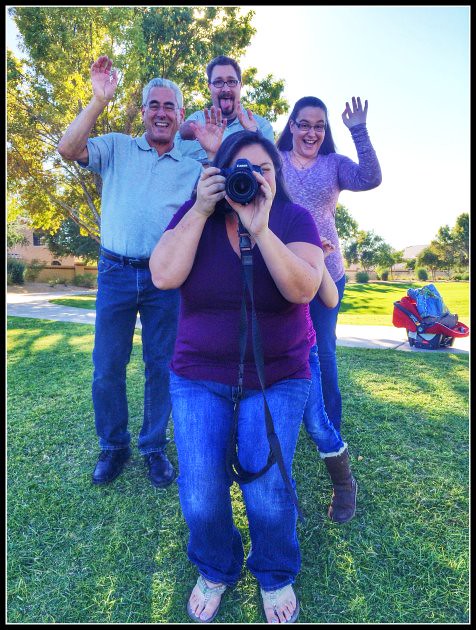
As I was getting my picture taken with granddaughter #2, Ellie, who is a year old and not always a cooperative subject, especially when momma isn't holding her, I began laughing at the antics going on behind the camera. And then I had to wonder... just how many people does it take to get a photograph?

It was a beautiful weekend and we went to a park by our house to take some pictures. We did groupings of grandparents & granddaughters, sisters and their kids, three generations and the like.
As I was getting my picture taken with granddaughter #2, Ellie, who is a year old and not always a cooperative subject, especially when momma isn't holding her, I began laughing at the antics going on behind the camera. And then I had to wonder... just how many people does it take to get a photograph?
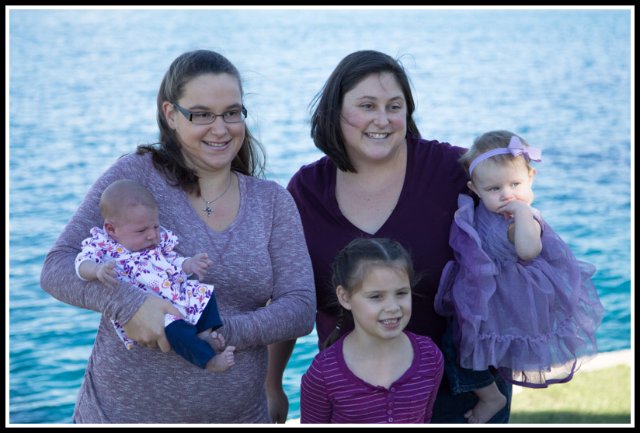
The good news is they finally got one!
And, also one of the girls - although by this time the kids were tired of posing and the wind was blowing hair around. Nevertheless, it is my favorite shot of our girls!
Hannah (almost 2 weeks), Janne, Jennifer, Lexie (6 years), Ellie (1 year)
Tuesday, November 18
sweetheart #6
Grandchildren (aka sweethearts) are the best thing since sliced bread. They love to spend time you you, don't mind getting smooches and will tell you things they won't tell anyone else.
You think you can't possibly love anyone as much as your spouse or children... until you have grandchildren. You are a little older and wiser than when you had your children and you know things like how quickly they grow up and to appreciate the everyday things.
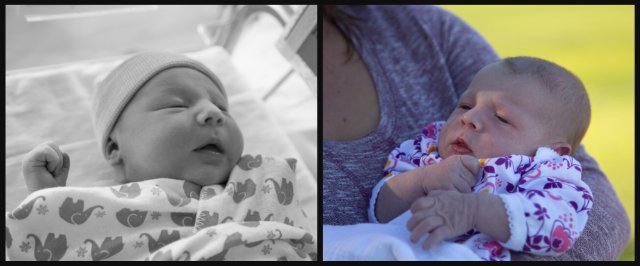
Two weeks ago we welcomed Sweetheart #6 into the world and our hearts. Like her five North Carolina cousins, she is a blessing to us... and will, undoubtedly, be spoiled just a little by us.
You think you can't possibly love anyone as much as your spouse or children... until you have grandchildren. You are a little older and wiser than when you had your children and you know things like how quickly they grow up and to appreciate the everyday things.
Two weeks ago we welcomed Sweetheart #6 into the world and our hearts. Like her five North Carolina cousins, she is a blessing to us... and will, undoubtedly, be spoiled just a little by us.
Hannah Beckett is a sweet little bundle of joy with a go-with-the-flow personality.
Wednesday, November 12
wacky wednesday - who knew???
Most kids, regardless of gender, like playing with LEGOS. Some kids like to use the "recipe" and build the fire truck or the Star Wars Death Star. Others like to use their imagination and create something entirely on their own.
Most LEGO sets are geared to children. Some sets are movie themed (Star Wars and The Lego Movie come to mind); others are based on superheroes (Batman, Superman, etc.) or everyday heroes (fireman and policemen, among others). Recently "girl sets" with princess or animal themes (with lots of pink bricks) have become popular. But at some point in childhood, most kids lose their fascination with the little interlocking bricks.
Or so I thought.
My sweet husband was googling the television show Big Bang Theory to purchase the last season on DVD and found this:

Most LEGO sets are geared to children. Some sets are movie themed (Star Wars and The Lego Movie come to mind); others are based on superheroes (Batman, Superman, etc.) or everyday heroes (fireman and policemen, among others). Recently "girl sets" with princess or animal themes (with lots of pink bricks) have become popular. But at some point in childhood, most kids lose their fascination with the little interlocking bricks.
Or so I thought.
My sweet husband was googling the television show Big Bang Theory to purchase the last season on DVD and found this:
What could be better than LEGOS & Big Bang Theory together?
(This is the fan model created by Alatariel & GlenBricker, not the actual set. You can see the complete set, minifigures (characters) and accessories they submitted here.)
Further research revealed that ANYONE can submit ideas to LEGO Ideas by creating a model, writing a project description, and following the guidelines and rules outlined by LEGO. The next step is gathering 10,000 supporters for your project. Once a project garners the required support, it enters the LEGO review phase where a review board of set designers and marketing representatives evaluate the project using criteria such as playability, safety and fit within the LEGO brand. All sets, fan ideas and internal ideas, go through this same process with the review board. If a fan's project is selected by the review board for production, the fan designer gets credit and a percentage of the sales. Awesome, huh?
In September, the LEGO review board announced several fan projects that made the cut and Big Bang Theory was one of them! You can see the others on the LEGO Ideas Blog - my Dr. Who friends will want to check it out for sure! And one of the projects is unlike any other I've seen.
The name LEGO is an abbreviation of the two Danish words "leg godt" meaning "play well." With sets for kids of all ages, everyone will play well!
Wednesday, November 5
wacky wednesday - what time is it?
Last weekend most of the country turned their clocks back one hour. The phenomenon known as "Daylight Saving Time" (DST - and no, it is NOT Daylight Savings Time) is a mystery to me. Perhaps it is because Arizona, with the exception of the Navajo Indian Reservation in the northeast part of the state, does not participate in such foolishness. But the whole idea of messing with time made me wonder when we began to actually keep time in this country and why we mess with it now.
Prior to the early 1880's, time of day in the United States was determined locally and varied from town to town. This would help explain the large discrepancies in arrival times for the stagecoach. It was generally determined by some solar method (a sundial, for example) and the town maintained a clock, usually in the clock tower or church steeple, with the "real time" for all the other clocks to be set by.
In 1883, standard time in time zones across the country were instituted by the U.S. and Canadian railroads. Although that made perfect sense so the railroads could maintain accurate schedules, the new system was not embraced by everyone - I guess change is always hard. The railroads, in particular, needed accurate schedules with standardized time to coordinate the trains so they didn't run into each other, especially on single tracks with only an occasional "passing lane." As the practical benefits became obvious, standard time became more popular and was finally established in U.S. law on March 19, 1918 with the Standard Time Act of 1918, also known as the Calder Act. The Calder Act also established DST which was about as popular as standard time in time zones was in the 1880's.
We like to think DST is a modern concept but there is evidence the ancient Romans used it and even our own Benjamin Franklin wrote a paper on the benefits (reducing candle use and allowing farmers to utilize child labor (their own children) without sacrificing education) of changing the clock to enhance daylight hours. Germany was the first country to implement DST in 1916 with most of Europe following shortly thereafter. The benefit at that time was to reduce the use of artificial lighting to save fuel for the war (WWI) effort.
Daylight saving time was repealed in the U.S. in 1919 but standard time in time zones remained the law of the land. The Interstate Commerce Commission was given authority over time zone boundaries but whether or not a region observed DST was determined locally.
Daylight saving time was re-established nationally (and internationally) during WWII (for the same reason as during WWI) but after the war its use varied among states and localities. This caused mass confusion in transportation schedules. The Uniform Time Act (1966) provided standardization for the dates DST was observed but still allowed states or localities to follow DST or not.
The current national system of DST was implemented by a federal law called the Emergency Daylight Saving Time Energy Conservation Act of 1973 in response to the oil shortage of that time and was made permanent a year later. Arizona sent petitions and politicians to Washington D.C. to fight for exemption from DST because it is cooler in the morning hours for farmers, construction workers, etc. to work. DST would force outdoor workers to begin their workday at earlier hours to take advantage of the cooler temperatures. Adding daylight hours in the evening just makes it light later while it is still hot outside and impacts when people can enjoy outdoor activities. For example, people would have to wait until 9:00 to go to a drive-in movie or play baseball on a field with lights rather than under the blazing sun. The Nixon Administration granted that Arizona (and Hawaii and several territories) be exempted from the law and it has remained that way since then.
So why does the Navajo Indian Reservation in northeastern Arizona participate in DST? The reservation spans four states - Arizona, Utah, New Mexico and Colorado - and three of them observe DST so it makes sense that the part in Arizona would also observe DST.
If having just one seventh of the state use DST isn't wacky enough, then how about the fact that inside the boundaries of the Navajo Indian Reservation resides the Hopi Indian Reservation which does not observe DST! Only in Arizona!
Prior to the early 1880's, time of day in the United States was determined locally and varied from town to town. This would help explain the large discrepancies in arrival times for the stagecoach. It was generally determined by some solar method (a sundial, for example) and the town maintained a clock, usually in the clock tower or church steeple, with the "real time" for all the other clocks to be set by.
In 1883, standard time in time zones across the country were instituted by the U.S. and Canadian railroads. Although that made perfect sense so the railroads could maintain accurate schedules, the new system was not embraced by everyone - I guess change is always hard. The railroads, in particular, needed accurate schedules with standardized time to coordinate the trains so they didn't run into each other, especially on single tracks with only an occasional "passing lane." As the practical benefits became obvious, standard time became more popular and was finally established in U.S. law on March 19, 1918 with the Standard Time Act of 1918, also known as the Calder Act. The Calder Act also established DST which was about as popular as standard time in time zones was in the 1880's.
We like to think DST is a modern concept but there is evidence the ancient Romans used it and even our own Benjamin Franklin wrote a paper on the benefits (reducing candle use and allowing farmers to utilize child labor (their own children) without sacrificing education) of changing the clock to enhance daylight hours. Germany was the first country to implement DST in 1916 with most of Europe following shortly thereafter. The benefit at that time was to reduce the use of artificial lighting to save fuel for the war (WWI) effort.
Daylight saving time was repealed in the U.S. in 1919 but standard time in time zones remained the law of the land. The Interstate Commerce Commission was given authority over time zone boundaries but whether or not a region observed DST was determined locally.
Daylight saving time was re-established nationally (and internationally) during WWII (for the same reason as during WWI) but after the war its use varied among states and localities. This caused mass confusion in transportation schedules. The Uniform Time Act (1966) provided standardization for the dates DST was observed but still allowed states or localities to follow DST or not.
The current national system of DST was implemented by a federal law called the Emergency Daylight Saving Time Energy Conservation Act of 1973 in response to the oil shortage of that time and was made permanent a year later. Arizona sent petitions and politicians to Washington D.C. to fight for exemption from DST because it is cooler in the morning hours for farmers, construction workers, etc. to work. DST would force outdoor workers to begin their workday at earlier hours to take advantage of the cooler temperatures. Adding daylight hours in the evening just makes it light later while it is still hot outside and impacts when people can enjoy outdoor activities. For example, people would have to wait until 9:00 to go to a drive-in movie or play baseball on a field with lights rather than under the blazing sun. The Nixon Administration granted that Arizona (and Hawaii and several territories) be exempted from the law and it has remained that way since then.
So why does the Navajo Indian Reservation in northeastern Arizona participate in DST? The reservation spans four states - Arizona, Utah, New Mexico and Colorado - and three of them observe DST so it makes sense that the part in Arizona would also observe DST.
If having just one seventh of the state use DST isn't wacky enough, then how about the fact that inside the boundaries of the Navajo Indian Reservation resides the Hopi Indian Reservation which does not observe DST! Only in Arizona!
Subscribe to:
Posts (Atom)
