I started this blog at the urging of friends and family in April 2010 when my husband and I were given an opportunity to relocate in Maryland for one year. We have now returned home to Arizona and continue to walk by faith as we watch God orchestrate the adventures in our lives. I invite you to share in our adventures as we watch God at work!

We live by faith, not by sight. 2 Corinthians 5:7


Showing posts with label Public Service Announcement. Show all posts

Wednesday, August 13

wacky wednesday - summer public service announcement #3... the perfect beverage

Everyone knows water is essential to our survival. But how much water is enough? And is there such a thing as too much water?

Experts recommend drinking at least eight 8-ounce glasses of water every day to stay well hydrated. When it's hot or very dry outside, or both like it is every day during summer in Arizona, we need even more water to help regulate body temperature and promote cellular function. If you wait until you are thirsty to begin drinking water, you are already slightly dehydrated. Activities like playing a sport, hiking or even doing yard work in outside temperatures over 100 degrees F. will quickly dehydrate a person, often seriously, if adequate water is not consumed before, during and after the activity.

Strenuous activity and/or hot weather cause the body to lose more water than normal through increased respiration and sweating. Early signs of dehydration include thirst and decreased urine output (darker-colored urine). Without adequate hydration, dry mouth, lack of tears, muscle weakness, nausea and vomiting, lightheadedness, heart palpitations, weakness, lack of sweating and increasingly decreased urine output occurs. In severe dehydration, confusion and severe weakness are followed by coma, organ failure and finally, death.

So, can you drink too much water? Yes, but with an asterisk :-). The cells in the human body maintain a delicate balance of water electrolytes (salt ions). When you gulp a lot (and I mean A LOT!) of water in a very short period of time, the cells in your body "swell." This is called water intoxication and fortunately, is relatively rare occurring most commonly in infants less than six months of age (usually due to over-diluting formula) and in long distance runners who don't drink electrolyte replacement drinks (usually due to stupidity). The swelling of the cells leads to electrolyte imbalances, most notably hyponatremia (low sodium) which is fatal if not corrected.

Summertime is often vacation-time. Remember to take extra water with you AND DRINK IT even if it's a short "hike" or "walk" (I sometimes fail to see the distinction between the two!). Going to Disneyland? Drink more water. Going to the Grand Canyon? Drink more water. Going to get the mail? Drink more water. Get the idea?
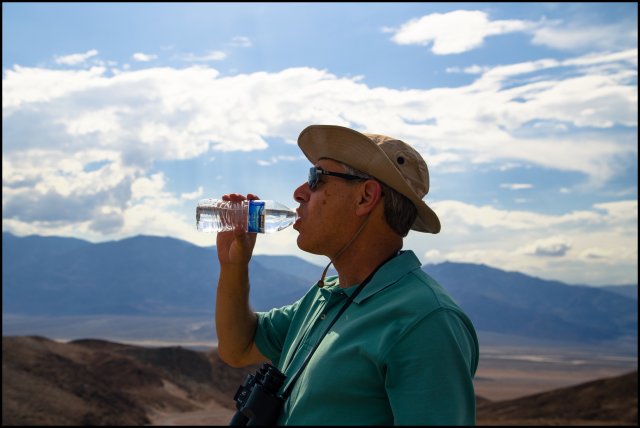
Water
On a recent trip to Death Valley National Park (yes, in the summertime - and it's beautiful!), we drank more than double our normal water intake as well as munched on salty snacks (pretzels) to replace lost sodium and water-laden ones (grapes) to further replace water. 

Enjoy summer but stay safe!

Tuesday, July 8

summer public service announcement #2 - cars get HOT

Summer is in full swing. Days are long. Temperatures are rising. And the interior of a closed car gets blisteringly hot.

In fact, when outside temperatures reach 100° F., even with windows partially open ("cracked") , the temperature in the interior of the car reaches 138° F. in just FIVE minutes - and up to 150° F. in 15 minutes! Of course, the hotter the outside temperature, the hotter the interior of the car becomes. Dark-colored vehicles and those with more windows (like hatchbacks) heat up more quickly.

So far this year (2014),  there have been THIRTEEN heatstroke deaths of children left in cars in the United States. Last year there were 44 deaths. Since 1998, 613 children have suffered heatstroke deaths and of those, 69% were either intentionally left in the car (a parent/caregiver runs a "quick" errand leaving the child in the car) or "forgotten" by the parent/caregiver. Seventy-three percent of the children were under the age of two - in other words, unable to save themselves. These are preventable deaths of children.

Every summer local and national news programs, the American Academy of Pediatrics, and various parenting groups launch public service announcements warning people of the dangers of leaving children in cars. No one (well, almost no one) wants to leave a child to die in a hot car. And everyone thinks it won't happen to them. But it can. And it does.

So what else can we do?

Last year a Tennessee fifth-grader, Andrew Pelham, decided to do something to help adults "remember" not to leave their kids in the car and raise awareness of the danger of leaving a child in a hot car. He designed the E-Z Baby Saver as his entry in the Rubber Band Contest for Young Inventors and was a national runner-up in the Engineering and Science Division. Andrew won a trophy and $500 with which he purchased a laptop and two Nerf guns (which he modified with rubber bands and duct tape!). He used his laptop to create his website, The E-Z Baby Saver, where he GIVES AWAY THE DIRECTIONS to make your own E-Z Baby Saver.

You will have to visit Andrew's website to see what the E-Z Baby Saver looks like - and I encourage you to do so. It is genius in its simplicity, practicality and use of inexpensive materials. While the E-Z Baby Saver won't save children who are intentionally left in a car, it could save the life of a child who is "forgotten."

Andrew not only has a head for business, he also has a heart for helping others. Do you? What would you do if you saw a child locked in a car in a parking lot on a warm day? Surprisingly, in a recent survey, about half of the adults who said they witnessed that situation walked on by without doing anything.

If you see a child (OR A PET!) left alone in a closed car, even if the windows are partially open, call 911 immediately and don't leave. The 911 operator will instruct you on what to do. Lives have been saved when strangers have gotten involved.

Enjoy summer but stay safe!

Wednesday, May 28

wacky wednesday - summer public service announcement #1 - can you swim?

I have lived in the Valley of the Sun essentially my whole life and do not remember a time I could not swim like a fish. My parents were, perhaps, a tad neurotic about water safety and taught my sisters and me to swim about the time we could run. When my husband and I had children, we taught them to swim... like fish... when they were toddlers. Living in an area where approximately 75% of homes have an in-ground pool and where lake communities are prevalent, it seemed like the prudent thing to do. And besides, swimming is fun! In my naiveté, I thought almost everybody knew how to swim at least enough to paddle around a pool.

So it was with interest that I read a recent article in the newspaper (USA Today, 5/20/14) about how many adults can swim well enough to save themselves should they fall in a pool. We are not talking Michael Phelps-type swimming but more like dog paddle-type swimming. I wasn't surprised to read that 80% of adults claim they can swim.

But what made my jaw drop and my eyes as wide as saucers was what came next - "but only 56% (of those 80%) can perform five critical water-safety skills that could save their lives, according to a new American Red Cross survey." And what are those five critical skills?

  1. Floating or treading water for one minute without a flotation device
  2. Stepping or jumping into water over your head and returning to the surface
  3. Treading water or floating in a full circle and then finding a way out of the water
  4. Exiting a pool without using a ladder
  5. Swimming (as in using any "stroke") 25 yards (the length of a standard pool) without stopping
So how could someone claim to be able to swim and not be able to do these five basic skills? I don't know. And how could an adult who can't save himself rescue his child from a pool? He could not. 

According to a recent Centers for Disease Control report 21,000 children and young adults drowned between 1999 and 2010. Drowning is one of the top three causes of unintentional injury death for people ages 29 and younger. And it is very preventable.

Temperatures are heating up and pools are warming up. If you cannot perform the five critical skills listed above, make this the summer you learn to swim. And while you're at it, take a CPR class (contact your local Red Cross for class information). The life you save may be your own or someone you love.