I started this blog at the urging of friends and family in April 2010 when my husband and I were given an opportunity to relocate in Maryland for one year. We have now returned home to Arizona and continue to walk by faith as we watch God orchestrate the adventures in our lives. I invite you to share in our adventures as we watch God at work!

We live by faith, not by sight. 2 Corinthians 5:7


Wednesday, August 5

wacky wednesday - pin mania

(This will be my last regular "Wacky Wednesday" post. I have been posting them for a year and a half and am ready for something different. Starting tomorrow you will find a "Thankful Thursday" post every Thursday. I will still write the occasional Wacky Wednesday post because... well, there are just so many wacky things to contemplate!)

Mickey Mouse ears, the popular black hat with the iconic ears attached, are the most popular Disneyland souvenir of all time. More than 84 MILLION have been sold at the park since it opened 60 years ago. I admit I have bought a pair.. or two... or more... myself. After all, embroidering your name on the back is included for "free" and they are just so... festive.

We used to see hundreds of people at Disneyland wearing their Mickey Mouse ears but in the past decade or so we have noticed a new trend gaining momentum - pin lanyards. You know, a fabric lanyard with Disney character pins attached. At first it was primarily the kids - pins were available soon after Disneyland opened in 1955 and they were a very affordable souvenir.  But pretty soon the adults got caught up in it and the real fun began as Disney realized they had a gold mine.

We thought it was kind of funny when we first started noticing adults with lanyards full of pins clanging as they walked. And sometimes it was hard not to stare at all the pins. I found myself chatting with people about their pins while we were waiting in line together. And I discovered that "pin people" were really friendly and enjoyed sharing stories about their pins. I learned it was about collecting pins but also trading them.

After the Millennial Celebration at Disneyland, cast members began trading pins with guests. Each day certain cast members were issued lanyards loaded with pins to trade. And, of course, guests can trade with each other. However, within the park, there are some rules: 1) Cast members MUST trade if a guest asks to trade a pin 2) Guests are not required to trade 3) Money or gifts cannot be used in trade for a pin.

My sweet hubby got his first lanyard last year and began collecting Toy Story pins. And Pluto pins. And then ride attraction pins. And a Monorail series. It's a fun hobby - talking to people, trying to complete a set, and looking at them when you get home and remembering the good times all over again.
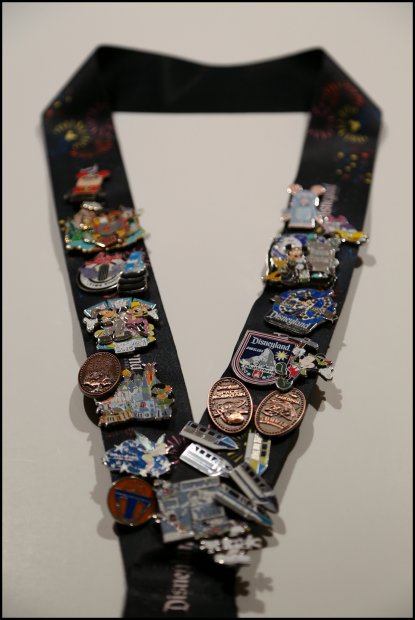
pin lanyard

A few of his favorite pins - mostly "keepers!"

Soon after he began collecting pins, we went to a D23 (the official Disney Fan Club) Mickey's of Glendale Shopping Event. It's where the employee store for the imagineers is located and they have official Disney merchandise (including pins!) you can't get at the parks. We arrived two and a half hours before the store opened to get in line. People were friendly and the time went by fast. 

After we got in line we learned that they were releasing a very limited edition (300) Frozen pin set (one giant pin and nine regular pins) priced at $200. For comparison, the most expensive regular pin at Disneyland is $15.99. The first 450 people in line got a ticket that enabled them to draw a piece of paper out of a bowl. If your paper had Elsa on it, you were allowed to buy one pin set, if it was blank, you got nothing. So you could have been the first person in line and not been able to buy one, or the 450th person in line and able to get one of the 300 pin sets. If you drew an Elsa paper, your name was written down and only you could buy it - you couldn't give the paper to someone else. 

To the amazement of the people in line around us, we had absolutely no intention of buying a Frozen pin set for $200. We quickly realized these were not the average pin traders at the park but were professional pin traders and sellers. They buy/trade for pins they like but they also buy/trade for pins they think will increase in value. It is almost a full-time job to constantly monitor pin-trading websites and groups to know when pin values peak. Several people told us they have made as much as $750 on a pin sale. Crazy, huh? 

The women behind us in line was friendly and answered my many questions.  She and I quickly became friends. She told us that these Frozen pins were predicted to skyrocket in value because of the popularity of anything Frozen, the exquisite workmanship of the pins and the very limited edition number. She was hoping to buy two sets (her daughter was with her so she got two chances for the Elsa paper). Since we weren't buying any, I told her she could have ours - or rather, we would buy it since we had to and then sell it to her for $200. 

We finally got to the head of the line to draw our papers. We drew one Elsa and one blank. My new friend drew two Elsa's. And she bought my pin set (yes, she came with cash!) - so she had a total of three. When I asked what she would do with them, she said she'd keep one for her daughter who loves Frozen and sell the other two.

Once we were inside the walled-off patio area, there were places to sit and relax. This was when the real fun began. We had another two and a half hours to kill before our time to go in the store (they limited the number of people allowed in since the store is relatively small). Suddenly pin binders opened up everywhere, white gloves came out and people were ready to trade. 

The professional pin traders keep their pins in their original packaging and only handle them with gloves. They all seemed to know (and like!) each other. It's not a competition and they don't try to undercut each other. Rather, they help one another find the pins they want, jointly find accurate values and build relationships. 

We learned about "scrappers" (pins that are flawed or don't make the cut in production and are scrapped) and "fakes" (knock-off pins usually made in China, where, incidentally, the official Disney pins are also made) and how to spot them since unscrupulous people will buy them to sell or trade. We learned the history behind some of the older pins. We learned some of the short-hand they all seem to speak. It was a fascinating experience!

We finally got inside the store, found some cute gifts and several pins that will be keepers, not traders but will not be worth any more than what we paid for them. As one of the professional pin traders told us, it's not about how many pins you have or how valuable monetarily they are. It's about enjoying the experience, the people and the pins you like.

Remember the Frozen pin set that originally sold for $200? Less than a year later it's listed on eBay for $900! Really crazy, huh?

Wednesday, July 29

wacky wednesday - a not so prickly subject

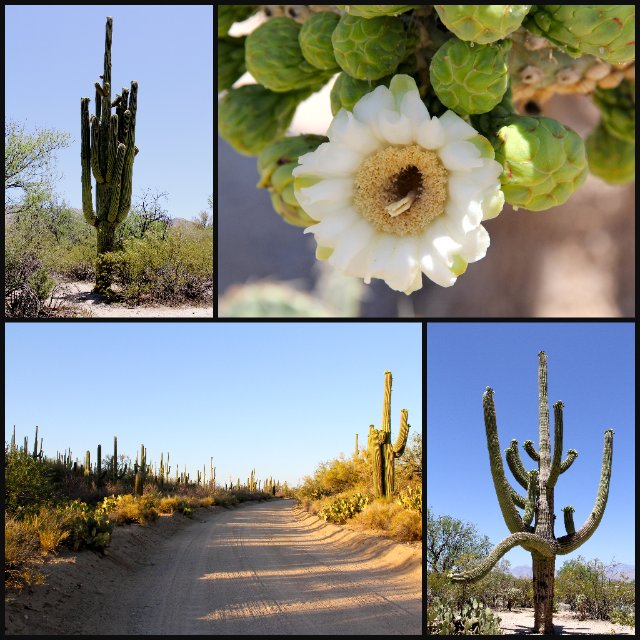
Having lived in the Sonoran Desert practically my whole life, I am no stranger to saguaro cactus. They are everywhere. Along the side of the freeways. In front yards. In the "natural desert" as you travel around Arizona. Arizona is the only U.S. state in which saguaros grow, although they also grow in Mexico.

I have always loved looking at them, so tall and majestic. They have white, waxy-looking flowers in the spring and red fruit in the summer which can be used to make wine, jelly and syrup. Two-armed saguaros remind me of people while the multi-armed (they can have as many as 25 arms!) ones look like space aliens, especially from a distance.

These cactus giants can grow to a height of 60 feet or more and weigh over one ton! I love how they draw my eyes upward.

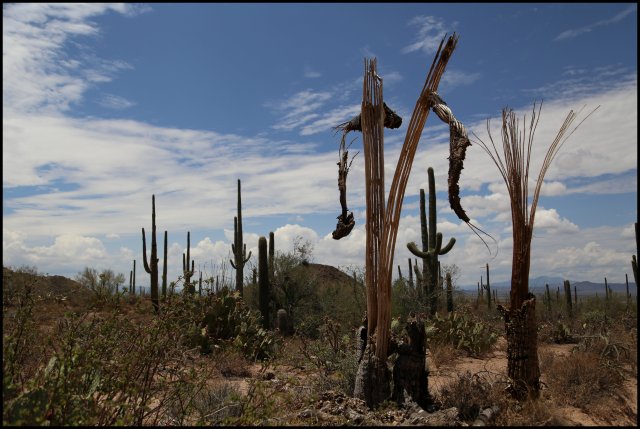
saguaro collage

The average lifespan of a saguaro is 150 to 175 years although some live more than 200 years. At the end of its life, the saguaro begins decomposing while still upright. The tough outer skin often takes a long time to peel off. Its five-foot long taproot that goes down deep to find water holds it erect while the massive, shallow (about three inches) root system that spreads out as wide as the cactus is tall decomposes. 

Soon, all that is left is the woody skeleton. The long ribs were once used by Native Americans and early western settlers in the construction of their homes and to make fruit-pickers. Now they are just pretty to look at. And fun to touch!

saguaro skeleton

Of all the cactus in the desert, the saguaros are my favorite. Even in death they are pointing to heaven and declaring the majesty of God. 

Wednesday, July 22

wacky wednesday - a diamond celebration

Walt Disney's career began in the 1920's in animation. Mickey Mouse debuted in 1928 in a short film, Steamboat Willie, one of the first sound cartoons. He has appeared in over 130 films, both short films and feature-length films. Children all over the world wrote to Walt asking if they could come see where Mickey Mouse lived.

At about the same time, Walt took his daughters to the park to play. As he watched them playing, he thought it would be wonderful if there was a place where parents and children could play together. And maybe meet Mickey Mouse. He pondered that for awhile and the "idea" of Disneyland was born.

First, think. Second, believe. Third, dream. And finally, dare.  ~ Walt Disney

Walt worked tirelessly on implementing his plan. There were setbacks, naysayers, and obstacles seemingly at every turn but Walt persevered.

Get a good idea and stay with it. Dog it, and work at it until it's done right.  ~ Walt Disney

And finally, after only a year in the making, on July 17, 1955, Disneyland opened with five "lands" (Adventureland, Frontierland, Fantasyland, Tomorrowland and Main St. USA) and 18 attractions!

If you can dream it, you can do it. Always remember this whole thing was started by a mouse.  ~ Walt Disney

Opening day was a disaster! Anaheim, California was in the middle of a record-breaking heat wave and the temperature on opening day reached 110 degrees. Asphalt that had been poured just the night before didn't set properly because of the heat and women's high heels (Yes, people dressed up back then! See Full Circle #2 post!) sunk in it. A plumber's strike left many drinking fountains without water. Six thousand invitations/tickets were mailed out and the park expected 11,000 people to show up but instead (due to many counterfeit tickets) 28,000 people crammed into the park. There were traffic jams trying to get into the park and restaurants ran out of food.

And the next few weeks weren't much better. But Walt didn't give up and ten years later, 50 million people had walked through the gates of Disneyland! Today, over 600 million people have visited "the happiest place on Earth!"

It's kind of fun to do the impossible.  ~ Walt Disney

Last Friday, July 17, 2015, Disneyland celebrated its 60th anniversary. The Diamond Celebration began earlier this year and is predicted to continue through the end of the year. New parades, fireworks, food and attraction make-overs are just a few of the "party favors" for this celebration. We went last month and think it's definitely worth seeing!

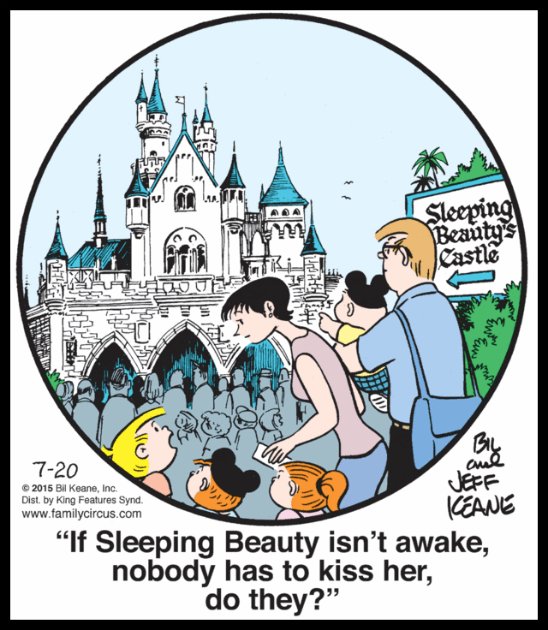
Some of my friends label me a Disneyland fanatic and as such,  I have enjoyed the well wishes and congratulatory messages from a variety of sources - in ads, on the news, in magazines and newspapers, on Facebook and even a nod from the comics!

Happy 60th Anniversary, Disneyland!

fc comic
In case you didn't know, Sleeping Beauty's Castle is at Disneyland, Cinderella's Castle is at the Magic Kingdom at Walt Disney World.

Wednesday, July 15

wacky wednesday - the astronaut wives club

I recently read the book The Astronaut Wives Club by Lily Koppel for a book club I facilitate. I chose the book for three reasons: 1) the "space race" is a topic I find interesting, 2) a majority of the book takes place in the late 1950's and 1960's - it would be a glimpse of "the good ol' days," and 3) a television series based on the book was about to air and I wanted to read the book before watching the show. One of the benefits of being a book club facilitator is choosing books you want to read ;-).


For the record, the book club LOVED the book and we had a great discussion about it. Some of the women were interested in the "space race" while others were not but Koppel did a great job of giving enough background to the various missions to give context to the story without overburdening the reader with scientific details. Everyone got pulled into the "race!" Most of the book club grew up during the 50's and 60's and loved the "walk down Memory Lane." And everyone was anxious to watch the television series which finally premiered on June 18, 2015 on ABC.

** Quit reading NOW if you haven't read the book and don't want anything spoiled for you!**

Before reading the book I assumed I would grow nostalgic for "the good ol' days" when much of the story takes place. I was really rather shocked to discover that was not the case.

Perhaps I was too young... or too naive... or just not paying attention during my growing up years, the "good ol' days" of the 1960's (I really don't remember the late 50's at all). Typical of most kids, I thought all people were like my parents, family and neighbors.

My parents always told me I could be anything I wanted when I grew up. I liked science and math and they encouraged me to pursue a career that would utilize those subjects. It never occurred to me that I might not be able to have a career in a predominantly male field.

Astrowife Trudy Cooper, wife of Mercury Seven astronaut Gordo Cooper, was an accomplished pilot who had aspirations of being an astronaut herself. When she vocalized those dreams to her husband and the folks at NASA, they laughed at her, saying a woman could never be an astronaut.

From the beginning, NASA told the wives what was expected of them - perfect marriages, perfect homes, perfect children - and it was the wife's fault if all was not perfect. They were "strongly encouraged" to make a deal with Life magazine - exclusive interviews in exchange for cars, life insurance on their husbands (who, because of their high-risk careers, were normally uninsurable) and "stuff" - so that the space program would be promoted. They were "coached" (read "told") on what to wear and how to portray themselves.

I realized from watching television shows like Leave It To Beaver and Father Knows Best as a child that society viewed women as homemakers, not career gals. Women's lib was still on the back burner if it was on the stove at all.

But what really took me by surprise as I read this book was how the astronauts' philandering was put up with. All but a very small handful of the early astronauts had affairs with "space floozies" or "Cape Cookies." The astronauts and their families had very nice homes in a special community near Houston where the family lived but the astronauts trained at Cape Canaveral (known later as Cape Kennedy) in Florida. They often spent weeks at a time at Cape Canaveral away from their families and, as they say, when the cat's away, the mice will play.

NASA knew about the philandering and in some ways, promoted it by not "disciplining" the wayward astronauts. The journalists at Cape Canaveral knew. The hotel staff knew. But NASA insisted that the squeaky clean image of the astronauts that they were portraying to the American public be maintained and wouldn't allow any of that to become public knowledge. I was dumbfounded that the journalists went along with the cover-up. When, exactly, had their professional integrity first been compromised? Was it then? Or earlier?

During a sermon not long ago at our church, my pastor said that the "good ol' days" really weren't. Perhaps they were better than today to some degree but they weren't "good" - there was still sin and evil in the world, as there is today. I agree. I built up an idyllic time in my memory fashioned from personal experiences as a child and applied it to the culture of the time. Reading about the real societal values and culture shattered my perception of "the good ol' days" resulting in my surprise.

While I didn't get nostalgic about the "good ol' days," I very much enjoyed the bond of friendship these women formed that lasted decades - through husbands' fiery deaths in the Apollo 1 tragedy, through affairs and divorce, through illness, through physical distance apart. Their husbands were so intensely competitive and the wives had to be as well, to some extent, but they were always there for each other when it counted. It was worth reading the book for that part of the story if for no other reason.

So the lesson I learned is that what I think I will enjoy about a book and what I actually enjoy may often be two entirely different things. I think that makes reading interesting!

Wednesday, July 8

wacky wednesday - the couch

You never know what you are going to find when you're geocaching. Sometimes it's the cache that's interesting or surprising. And sometimes it's something totally unrelated to geocaching that you stumble across while you're looking for the cache.

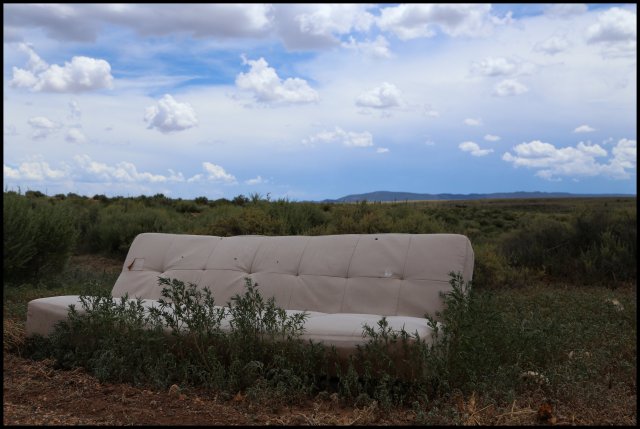
We were geocaching this past week in the high country of Arizona, east of Flagstaff. The cache itself was pretty uninteresting - typical container, typical location, nothing historical about the locale. But what we passed looking for the cache caught my eye... and my camera lens!

couch

I think there is a story behind this futon couch being dumped in the middle of nowhere. I refuse to believe that someone loaded it on a truck and dumped it miles from anywhere rather than take it to the dump or donate it to a charity. 

So... 

Once upon a time, a lovely married couple decided to move into a smaller condo in order to donate more of their money to those less fortunate than themselves. They painstakingly went through all their belongings, keeping only the things they absolutely needed. 

Their hearts were full of joy until they came to their futon couch. They often sat together on the couch, holding hands and talking about their day, watching a movie or reading a book together. They couldn't bear to part with this couch that was so much a part of their lives but it wouldn't fit in their new condo.

Their hearts were broken until the wife had an idea.

In the dark of night, they moved the couch to a deserted field in a remote area miles from buildings or even well-traveled roads. They positioned it facing north so they could watch the sunrise or the sunset as they sat together, holding hands and talking about their day.

Once again, their hearts were full of joy and they lived happily ever after.

Yeah, I know. But that's my story and I'm sticking to it. I'd rather think the best of someone than the worst.

Wednesday, July 1

wacky wednesday - full circle #2?

I was four years old the first time I went to Disneyland. I was there with my parents, my older sister and my younger sister. While I have vivid memories of that trip to "the happiest place on earth," I did not pay much attention to the subject of this post - shoes. Except that I lost one of my shoes on the Jungle Cruise when the captain fired his gun at the alligators and I hid under my seat.

Kristin at DL-1960_0002
(October, 1960)
I am the girl with the lei - and no, I don't know why I had one. What strikes me about this photo is my mom's shoes. She had on high heels! We were dressed up. Everyone there was dressed up. And women had on heels.

I have been to Disneyland many, many times since that first visit and have noticed that what people wear, both clothing and shoes, has changed over time. In general, I think it has changed for the better.

Clothing has become more casual. For the past several decades, shorts or jeans and shirts are the order of the day. Styles change with the times but I seldom see anyone "dressed up" except for the occasional older Asian gentleman in a suit and tie.

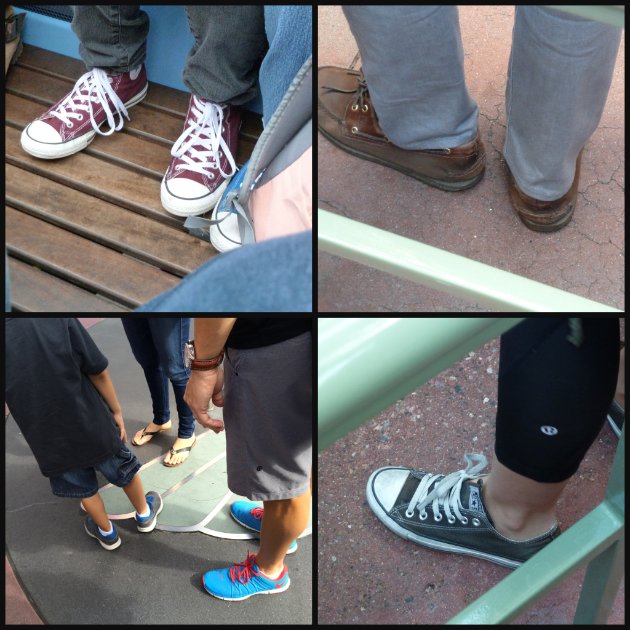
Shoes also became more casual with the vast majority of people wearing tennis shoes (sneakers?) or more commonly now, flip flops.

tennis shoes collage
Happy feet like comfortable, sensible shoes!

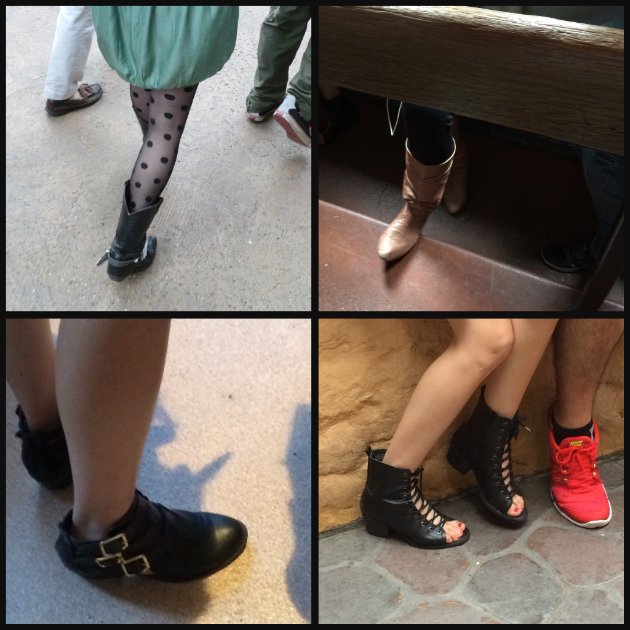
However, in the last five years or so I have noticed a trend among the younger women back to dressier shoes. This trend is only for the women though, guys still wear comfortable, sensible shoes. I have watched women tottering about in five-inch stiletto heels fall on the uneven surface of the paths. Some women actually limp along in very uncomfortable-looking shoes. By late afternoon it is common to watch these women shift their weight back and forth from one foot to the other as they wait in line. Pain is etched in their face.

shoes collage
It is not uncommon for the average Disneyland guest to walk a minimum of five miles a day. We have walked as much as 12 miles a day. None of these shoes (with the exception of the red tennis shoes the guy has on!) would be comfortable for that amount of walking.

It seems that we have come full circle in just 50 years or so. Women again choose fashion over comfort.

Wednesday, June 24

wacky wednesday - is more better?

Digital cameras and smartphones completely changed the way we view personal photography - everything from how many photos we snap to what we photograph and even how we store our photos.

The advent of the "selfie" dramatically increased the number of photos being taken every day. Researchers estimate more than 93 million selfies are taken every day. (And in case you're interested, the Philippines is the selfie capital of the world.) FaceBook claims more than 350 million photos are uploaded to their site every day. Estimates for the total number of photos taken in 2014 range from 880 BILLION to one TRILLION! That's about a quarter of the total number of photos taken EVER.

Personally, I went from shooting two 24-exposure rolls of film on a one week vacation to shooting over 1000 images on a similar one week vacation. It cost no more to shoot 1000 images than it did to shoot 48 and the likelihood of getting a great shot dramatically increased. Of course, it also means I have OVER ONE THOUSAND vacation photos to sort through on my computer before I print any.

Film and developing were costly so I used to really think about whether or not I wanted to take a particular photo. I would get irritated with my kids if they were being goofy and I wanted a serious shot. I seldom took photos just to capture our everyday life; they were more event related like a birthday or holiday or the first day of school. Now I shoot more "frivolous" photos - things like the Dole Whip we had at Disneyland or people I don't even know doing stupid things at national parks. I experiment more, trying new things just to see if I can figure them out or if they will work. And I always get the goofy shots!

Boxes. That's where I used to store my prints after I got my film developed until I had time to put them in scrapbooks. And I kept my negatives at someone else's house so a fire wouldn't destroy everything. Now, my digital images are stored on my hard drive and an external drive. And I have several backups. I'm not sure which is better. The digital images take up waaaaaay less room but out of sight is also out of mind. I find I print fewer photos and it's easier to put off scrapbooking them. Having a limited amount of physical space to store photos made me stay more current with putting them in scrapbooks, swapping out photos in frames and discarding the ones I didn't want to keep.

So, is more really better? Ummmm. Yes. And no. Or maybe it's just different now.